
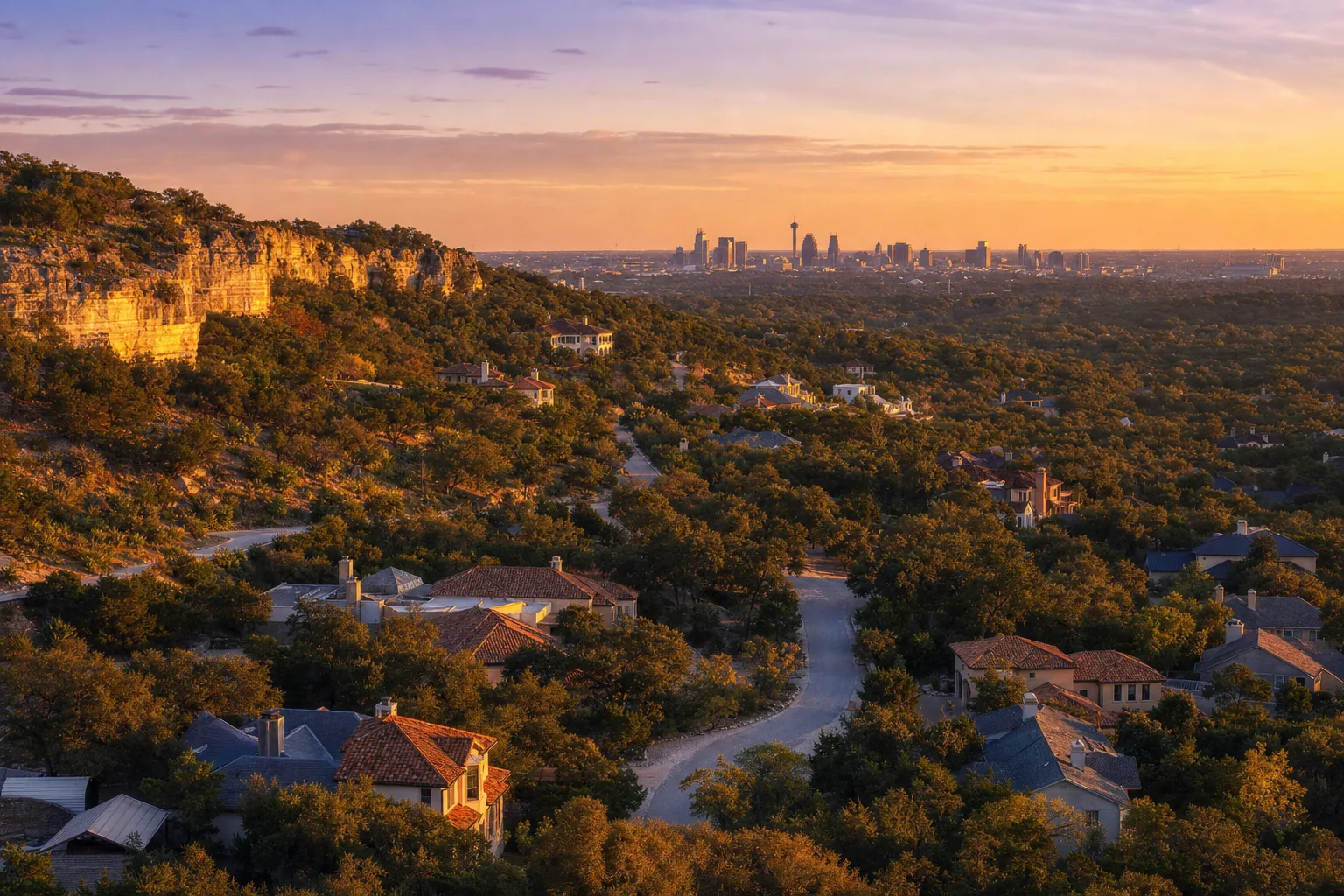
Roughly 77,000 to 98,000 Californians move to Texas every year — the largest interstate migration flow in the country, according to Texas REALTORS® data and StorageCafe's Census analysis. About one in seven of them lands in the San Antonio-New Braunfels metro.
Most of the relocation content on the internet is written by people who have never worked a California-to-Texas transaction. It is either boosterism ("Texas has no income tax!") or fear-mongering ("Texas taxes are worse than California!"). The truth is more useful than either.
Here is the real math, the honest trade-offs, and the ten questions every California buyer asks me — in the order they usually ask them.
Why Californians Are Choosing San Antonio Specifically
California-to-Texas migration is not new, but the destinations have shifted. Ten years ago the story was Austin. Five years ago it was Austin and Dallas. Today, more Californians are landing in San Antonio than at any point in the last decade — and it is not because Austin got expensive. It is because San Antonio quietly became the value play.
The San Antonio-New Braunfels metro absorbed roughly 159,000 new residents in the year ending May 2025, per the Hire A Helper 2025 Texas Migration Report. It is the third-largest metro destination in Texas behind Dallas-Fort Worth and Austin, and it is growing faster than either in percentage terms because it started from a lower base.
What $700,000 Buys
Los Angeles or San Francisco Bay Area: A one- or two-bedroom condo in an aging building, often with HOA fees above $600 a month.
San Antonio Hill Country: A 3,500–4,500 square-foot custom home on a quarter- to half-acre lot in Boerne, Bulverde, or Stone Oak, often with a pool, a three-car garage, and access to top-rated schools.
The San Antonio Housing Market in 2026, By the Numbers
San Antonio's median sale price in mid-2026 lands somewhere between $290,000 and $335,000 depending on which data source you trust. Redfin pegs it at $265,000 across the three months ending June 2026. Zillow shows an average home value of $249,689 and a median sale price of $287,667. Homes.com reports a June 2026 median of $330,000. Bexar County MLS data shows a $304,450 median across the most recent 1,000 single-family closings through August 2026.
All of these numbers are correct — they just measure slightly different things (new construction inclusion, condo inclusion, metro vs. city limits). The honest range for what a California buyer moving to San Antonio should budget on a mid-market family home is $300,000 to $500,000, with luxury landing between $700,000 and $2 million and estate homes above that.
| Metro | Median Sale Price (mid-2026) | Median $/sqft |
|---|---|---|
| San Antonio, TX | $290K–$335K | $155–$170 |
| Austin, TX | $425K | $285 |
| Dallas–Fort Worth, TX | $375K | $210 |
| Los Angeles, CA | $860K | $620 |
| San Francisco Bay Area, CA | $1.3M | $980 |
| San Diego, CA | $900K | $715 |
Homes are also selling slower than they were during the 2021–2022 frenzy. The average days on market in San Antonio is 72 to 79 days. Sellers are netting 97 to 98 percent of list price. This is a negotiable, well-supplied market — a real advantage for California buyers who are used to bidding wars.
The Tax Math That Actually Matters
Here is where California buyers get the biggest surprise, and where a lot of internet advice is wrong in both directions.
What you save: state income tax
Texas has no state income tax. California's marginal rates run from 1% to 13.3%. For a household earning $250,000 in California, the state tax alone is roughly $20,000 to $22,000 a year. That number goes to zero in Texas.
For a household at $500,000, the savings are closer to $50,000 to $55,000 annually. This alone often justifies the move within the first two to three years even accounting for moving costs and closing costs on both ends.
What you pay more of: property tax
Texas has some of the highest effective property tax rates in the country. In the San Antonio metro, effective rates run 2.1% to 2.6% depending on the taxing district (school district, city, county, MUD, ESD, and sometimes flood control). California under Proposition 13 caps effective property tax at approximately 1.1%, and the assessed value can only increase 2% per year until the property changes hands.
$800,000 California home vs. $500,000 San Antonio home
California (1.1% effective on $800K): ~$8,800/year
San Antonio (2.3% effective on $500K, with homestead exemption applied): ~$8,400–$9,200/year
On roughly comparable family homes in each market, total property taxes are within a few hundred dollars of each other — even though the effective rate is more than double. The lower purchase price offsets the higher rate.
The homestead exemption is a critical variable. Texas Tax Code Section 11.13(b) requires school districts to provide a $140,000 exemption on your primary residence. Taxing units can add up to 20% more on top. Once the exemption is filed, your assessed value cannot increase more than 10% in any given year — a Texas version of California's Prop 13 cap, though with a higher ceiling.
I wrote a full Bexar Homestead Exemption Guide that walks through the filing deadlines and exact forms. File it. Every year I see California transplants who did not, and they leave thousands on the table.
The 10 Questions Every California Buyer Asks
1. How much home can I get in San Antonio compared to California?
The compressed answer: the same $700,000 that buys a two-bedroom starter condo in Los Angeles or the Bay Area buys a 3,500 square-foot custom home on a half-acre lot in Boerne or Stone Oak. At $1 million, you are in The Dominion or Cordillera Ranch — guard-gated luxury communities with country club membership. At $1.5 million and up, you are looking at Hill Country estate acreage with private access to the Guadalupe River.
The rule of thumb I give California buyers: expect roughly 3x the square footage and 3x the lot for the same money, plus the ability to pay cash on more properties than you could in California.
2. Does San Antonio really have no state income tax?
Yes. Zero. There is no filing requirement, no state return, no bracket. This is the biggest lifestyle change in a way that is not just financial — no April 15 state deadline, no state estimated payments, no state tax withholding line on your paycheck.
What Texas does have: sales tax (8.25% in Bexar County), franchise tax on businesses over $2.47 million in revenue, and the property taxes discussed above. For most W-2 households, the net position is a large positive.
3. How high are San Antonio property taxes really?
See the section above. Short version: high rate, lower base, generally close to net-neutral versus a comparable California property when you factor in the homestead exemption. The important thing is to underwrite your monthly PITI payment using the correct effective tax rate for the specific taxing district. On a $500,000 Stone Oak home, that is a monthly tax bill of $800 to $950 — often 30% of your total mortgage payment.
4. How is the weather in San Antonio compared to California?
Californians moving to San Antonio need to prepare for three things: summer heat, humidity, and thunderstorms.
Summer: June through early October, highs of 95 to 105 degrees. It cools to the mid-70s at night. The humidity is real — 60 to 70 percent typical, which makes the perceived temperature five to ten degrees hotter than the thermometer says. Every home has central AC and every business is heavily air-conditioned.
Winter: Mild. Daytime highs in the 60s, nighttime lows in the 40s. A hard freeze happens two to six nights per year, usually in January or February. Snow is rare (once every three to five years, briefly).
Spring and fall: The best months. April, May, October, and November are consistently gorgeous — 75-degree afternoons, cool mornings, wildflowers along the highways in April.
What you do not get: wildfire season, meaningful earthquakes, or the June Gloom marine layer. Californians used to coastal fog usually appreciate the consistency of San Antonio sunshine, even if the summer heat takes a season to adjust to.
5. Are San Antonio schools good for families relocating from California?
The San Antonio metro has fifteen independent school districts, and quality varies significantly by district. The consistently top-rated public districts are:
- Alamo Heights ISD — small (three schools), historically top-3 in Texas for academic ratings. Attendance zone is roughly Terrell Hills, Alamo Heights, and Olmos Park.
- Boerne ISD — Champion High School and Boerne High School both rank in the top 5% of Texas public schools. Covers Boerne, Cordillera Ranch, Fair Oaks Ranch, and parts of Bulverde.
- Comal ISD — Smithson Valley area, growing fast, strong programs in Bulverde.
- Northside ISD — Massive district (100,000+ students), quality varies dramatically by attendance zone. Reagan HS, Clark HS, and Brandeis HS are among the best in the metro.
- North East ISD — Similar variability. Churchill HS and MacArthur HS are the top zones.
Private options include Saint Mary's Hall (K–12, top-rated), TMI Episcopal, Keystone School, San Antonio Christian School, and Antonian College Prep. Tuition ranges from $18,000 to $35,000 annually — substantially less than comparable California private schools.
The most common California-to-San Antonio mistake I see is buying a home before verifying the specific attendance zone. Do not trust a listing's stated school assignment. Verify directly with the district before you write an offer.
6. What jobs are available in San Antonio?
San Antonio's economy is anchored by five sectors:
- Military and federal. Joint Base San Antonio combines Fort Sam Houston, Lackland AFB, and Randolph AFB into the largest single Department of Defense installation in the world. Roughly 80,000 active-duty, civilian, and contractor jobs.
- Healthcare. Methodist Healthcare, University Health System, Baptist Health, and San Antonio Military Medical Center (BAMC) — the busiest Level I trauma center in the DoD. Medical is San Antonio's largest private-sector employer group.
- Financial services. USAA is headquartered here (33,000+ San Antonio employees). Frost Bank, Argo Group, and multiple regional banks add to the base.
- Cybersecurity. San Antonio is nicknamed "Cyber City USA" — the largest concentration of cybersecurity professionals outside the DC metro. Anchored by the 24th and 25th Air Forces at Lackland, plus dozens of private contractors.
- Aerospace and manufacturing. Boeing has a major maintenance facility at Port San Antonio. Toyota's largest North American truck plant is on the south side.
Tech is growing but the ecosystem is smaller than Austin or Dallas. Remote workers relocating from California tech companies often keep their existing jobs, take a slight cost-of-living pay adjustment if their employer requires it, and net far ahead financially.
7. How is the commute in San Antonio compared to California?
San Antonio's average commute is 25 to 27 minutes. Los Angeles is 32 to 34. Bay Area is 35 to 40. The metro is spread out but not congested by California standards — even at rush hour, most suburb-to-downtown routes take 20 to 35 minutes.
Loop 1604 and Loop 410 are the two main ring roads. Interstate 10 runs east–west, I-35 runs north–south. The Hill Country suburbs (Boerne, Bulverde, Fair Oaks Ranch) sit outside 1604 and add 15 to 25 minutes to downtown. The northeast suburbs (Schertz, Cibolo, Universal City) are 20 to 30 minutes from downtown and 15 minutes from Randolph AFB.
There is no meaningful public transit for suburban commuters. Plan on driving. Two-car households are standard.
8. What should Californians do first when they arrive in San Antonio?
Six things in the first 90 days:
- Texas driver's license within 90 days. Any DPS office in Bexar County. Bring proof of residency (utility bill or lease), your California license, and a passport or Social Security card.
- Vehicle registration within 30 days. At the Bexar County tax office. Vehicles need a Texas safety inspection before registration.
- Voter registration. Update via mail or in person at the Bexar County Elections Department.
- File the homestead exemption after closing. Application must be filed with the Bexar Appraisal District before April 30 of the year following purchase. Locks in the 10% annual assessed-value cap. Do not skip this. See our step-by-step guide.
- Transfer utilities. CPS Energy (electric and gas), SAWS (water), and your choice of internet provider (Spectrum, AT&T Fiber, Google Fiber in some ZIPs).
- Health insurance. Update to a Texas-based plan or verify your current one has Texas providers. California PPO networks often do not extend well into Texas.
9. Is San Antonio safe?
Like every major US metro, safety depends on neighborhood. The suburbs I most often place California families in — Terrell Hills, Stone Oak, Shavano Park, Boerne, Cordillera Ranch, The Dominion, Bulverde, and Helotes — consistently rank among the safer suburbs in Texas.
Downtown and the immediately surrounding urban core have higher property crime rates than the suburbs, similar to any major US city. Californians moving from the Bay Area, LA suburbs, or Orange County typically feel their safety level is similar or slightly better in equivalent San Antonio neighborhoods.
10. How do I get a mortgage in Texas if I still have a California income?
This is the question I answer every week. The short answer: you can absolutely qualify for a Texas mortgage with California income — most of my California relocation clients do exactly that.
If your job is remote or portable: lenders use your existing California income with no restart clock. No employment change means no seasoning requirement. The main thing to watch is that your California employer accepts your Texas address on payroll (most do; some require paperwork).
If you are changing jobs to a Texas employer: most conventional lenders require 30 days of pay stubs from the new job before closing. Some accept an offer letter with a firm start date and a "borrower will begin employment" clause. This is where a lot of California buyers get tripped up — they assume they need to move first, then buy. They do not. We can close on the Texas home before the first day of the new job with the right lender.
If you are self-employed: California-based sole proprietors and S-corp owners qualify with the same two-year tax returns Texas lenders use for any self-employed borrower. The state change does not restart any income clock.
Why This Matters for California Buyers
Most California-to-Texas relocations involve two moving parts: selling the California home and buying the Texas home. Timing matters enormously — closing costs on both ends, bridge financing, temporary housing, and moving logistics all interact.
As a dual-licensed REALTOR® and Mortgage Loan Officer, I can pre-underwrite your loan while you are still in California, so you land in San Antonio with a clean approval, not a cold start. Same person, same file, same phone number.
Which San Antonio Neighborhoods Fit California Buyers Best
I get this question every week from Californians who have never set foot in San Antonio. Here is the short version:
- Coming from the Bay Area or Orange County luxury market ($1M+ California budget): Look at Cordillera Ranch, The Dominion, or Anaqua Springs. Guard-gated, country club amenities, top schools.
- Coming from the LA suburbs or San Diego ($700K–$1.2M budget): Stone Oak, Shavano Park, or Boerne. Established master-planned communities, strong schools, 20-minute drive to downtown.
- Coming from Sacramento or the Inland Empire ($400K–$700K budget): Schertz, Bulverde, Helotes, or the north-side portions of Northside ISD. Newer construction, family-oriented, strong appreciation over the last decade.
- Coming from Central or Northern California with a smaller budget ($300K–$400K): Look east and northeast — Cibolo, Universal City, or older Northside neighborhoods. Solid value, established communities.
Every one of these neighborhoods has its own detailed guide on this site. Read the pages before you fly in — I have written each one to help California buyers screen out the areas that will not fit their lifestyle.
The Move Itself: Costs, Timing, and What to Ship
Full-service California-to-Texas moves typically cost $8,000 to $18,000 for a family home's worth of belongings, depending on volume and season. Container-based moves (PODS, U-Pack) run $4,000 to $8,000 if you do your own packing. Peak season is May through August — plan on paying 20–30% more if you move during that window.
Ship your furniture. Do not ship: outdoor plants (Texas quarantines many California species), old appliances (Texas gas and electric standards differ), and anything with a wildfire smoke smell (it will not come out and Texas humidity makes it worse). Do ship: everything else.
Set up utilities and internet two weeks before your closing date. CPS Energy activation typically takes 24–48 hours if you schedule ahead; same-day activation runs the risk of a 3–5 day delay during summer heat waves.
What I Do for California Relocation Clients
I have closed dozens of California-to-San Antonio transactions since 2018 — from tech professionals with remote jobs to retirees selling in Marin, from military families rotating in to entrepreneurs relocating their businesses. The pattern is the same: California buyers need someone who can answer both real estate and mortgage questions in the same conversation, who understands the tax delta they are running toward, and who can pre-position financing so they land in San Antonio ready to close.
That is what my practice is built to do. If you are anywhere in your California-to-San Antonio process — six months out or six weeks out — I would be glad to set up a free 30-minute call to answer whatever question is next on your list. No pitch. No pressure. Just an honest read on your specific situation.
Considering a move from California to San Antonio?
Book a free 30-minute consultation and get a straight answer on your specific situation — home budget, mortgage pre-approval, timing, neighborhoods. No pressure. Just clarity.